
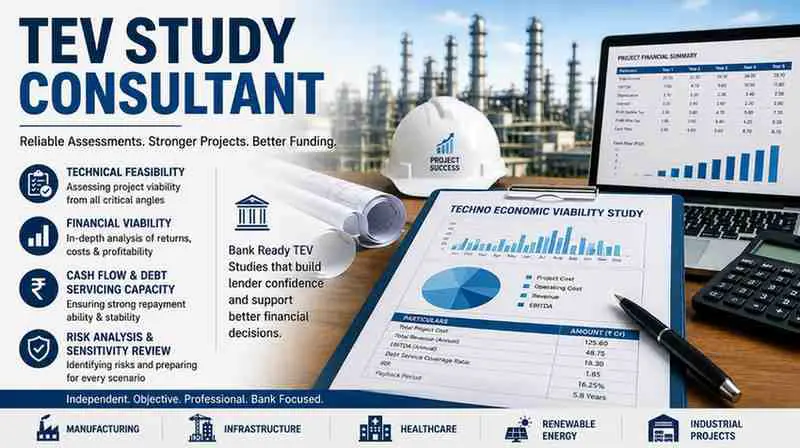
Many business owners begin their funding journey by preparing financial statements, collecting quotations, and putting together a project proposal. They assume that once these documents are ready, the bank will process the loan without much difficulty. In practice, things rarely move that smoothly. This is where a TEV Study Consultant becomes important.
A Techno Economic Viability study is not just another document added to the loan file. It is an independent assessment that helps lenders understand whether a proposed project is technically feasible, financially sustainable, and capable of generating enough cash to repay the loan over time. Banks and financial institutions are lending public money, so they need confidence that the project has been examined from every important angle.
A good TEV Study Consultant studies far more than projected revenue. The consultant reviews market demand, production capacity, technology selection, implementation timelines, capital expenditure, operating costs, profitability, cash flows, and financial risks before presenting a balanced opinion. The objective is not to make every project look attractive but to identify both strengths and potential concerns before they become expensive problems.
Take the example of a manufacturing company planning to expand its existing production unit. The promoter may believe that demand will continue growing because orders have increased during the past year. However, a TEV study may reveal that additional investment in utilities, logistics, or skilled manpower has not been considered. Identifying such gaps before the loan application reaches the bank can save months of unnecessary back and forth.
Similarly, a solar power developer may have secured land and equipment suppliers but overlooked evacuation infrastructure or regulatory approvals. A TEV Study Consultant examines these practical issues because lenders expect projects to be executable, not just financially attractive on paper.
"A TEV Study Consultant provides the independent assessment that banks and businesses need before committing significant capital. The objective is not to make every project look perfect, but to identify both strengths and potential concerns before they become expensive problems." — Frontline Consultants Team
Many financial institutions now consider independent project evaluations an important part of their credit appraisal process, particularly for large manufacturing projects, infrastructure developments, hospitals, educational institutions, renewable energy ventures, warehouses, and industrial expansions. An objective TEV study provides lenders with greater confidence while helping borrowers present a well-supported proposal.
Another benefit is that the process often uncovers issues that business owners themselves may not have noticed. Working capital assumptions, project implementation schedules, debt servicing capacity, sensitivity analysis, and cost estimates are areas where even experienced promoters can make optimistic assumptions. Correcting these before submission usually leads to a smoother appraisal process.
This doesn't apply everywhere. Smaller loans or standard lending products may not always require a detailed TEV study. However, as project size, complexity, or funding exposure increases, banks generally seek deeper technical and financial validation.
Many promoters also believe that preparing a DPR is enough for getting a loan. In reality, that rarely happens for larger projects. A Detailed Project Report explains the business proposal, while a TEV study independently evaluates whether the proposal is practical, financially viable, and capable of meeting lender expectations.
With more than three decades of experience, Frontline Consultants has supported businesses, promoters, lenders, and financial institutions by preparing comprehensive TEV studies that align with banking requirements while reflecting the practical realities of Indian industries. The emphasis is always on presenting an honest assessment rather than creating unrealistic projections that may create difficulties later.
Understanding What a TEV Study Really Evaluates Beyond Project Costs
One of the biggest misconceptions about a TEV study is that it simply verifies project cost estimates. That is only one part of a much broader exercise.
An experienced TEV Study Consultant examines whether the proposed business can actually operate successfully after the project is completed. Cost estimates matter, but lenders are equally interested in how the project will perform over the next several years.
The technical review begins by assessing the project's basic feasibility. Is the selected technology suitable for the intended production? Are the machines capable of delivering the proposed capacity? Is the location appropriate? Are raw materials consistently available? Does the implementation schedule appear realistic? Questions like these influence the success of the project just as much as financial planning.
The financial analysis goes much deeper than projected profit figures. Banks typically want to understand expected revenue, operating margins, debt servicing ability, cash flow generation, break even timelines, working capital requirements, and the borrower's capacity to withstand adverse market conditions.
Example: Hospital Project
Consider a hospital project seeking long term finance. Construction cost may be estimated accurately, but what if occupancy projections are overly optimistic? What if specialised doctors cannot be recruited within the planned timeline? What if equipment maintenance costs have been underestimated? A TEV Study Consultant evaluates such practical assumptions because they directly affect future cash generation.
Example: Warehouse Expansion
A warehouse expansion may appear financially attractive based on projected rental income. However, if road connectivity, logistics demand, statutory approvals, or tenant availability have not been properly analysed, the project could face delays that impact loan repayment.
I might be wrong here, but I have often noticed that promoters spend far more time negotiating machinery prices than reviewing long term cash flow assumptions. Ironically, lenders usually focus more on repayment capacity than on minor differences in equipment cost.
A well prepared TEV study also includes sensitivity analysis, examining how changes in sales, production levels, operating expenses, or project completion schedules may affect financial performance. This helps banks understand how resilient the project remains under different business conditions.
Sometimes perfectly good projects get delayed because documentation was prepared in the wrong sequence. It still surprises me.
The overall purpose is not to predict the future with certainty. Instead, the study provides a structured assessment of whether the project has been planned carefully enough to justify financial assistance.
Situations Where Businesses Commonly Need a TEV Study Consultant
Not every business requires a detailed TEV study. However, several situations make the involvement of a TEV Study Consultant highly valuable for both borrowers and lenders.
- Manufacturing companies – Establishing new production facilities or expanding existing plants
- MSMEs – Applying for term loans, working capital enhancement, or technology upgradation
- Renewable energy projects – Solar parks, rooftop solar, wind energy, and hybrid systems
- Healthcare projects – Hospital expansions, diagnostic facilities, and medical infrastructure
- Industrial warehouses and logistics – Project finance or refinancing for storage facilities
- Debt restructuring cases – Fresh assessment of repayment capability under revised arrangements
- Large credit exposures – Where banks themselves appoint independent consultants for consortium lending
With more than 30 years of experience, Frontline Consultants has worked across manufacturing, infrastructure, renewable energy, healthcare, education, logistics, and industrial sectors, helping businesses prepare reliable TEV studies that satisfy lender expectations while giving promoters greater clarity about their own projects before significant financial commitments are made.
How the TEV Study Process Supports Better Lending Decisions and Project Planning
A well prepared TEV study does much more than satisfy a lending requirement. It gives both the borrower and the lender a clearer understanding of whether the project has been planned realistically. In many cases, the process itself improves the quality of the project before financing is approved.
An experienced TEV Study Consultant begins by understanding the purpose of the project. Is it a greenfield manufacturing unit, an expansion of an existing factory, a hospital addition, a warehouse development, or a renewable energy project? Every industry has different technical requirements, operating risks, and revenue drivers. A standard checklist simply cannot capture those differences.
The consultant then reviews the technical aspects of the project. Machinery selection, production technology, implementation schedule, plant layout, utility requirements, availability of raw materials, manpower planning, statutory approvals, and infrastructure readiness are all examined carefully. These may sound like operational details, but they often determine whether a project starts on time or faces avoidable delays.
The financial review follows alongside the technical assessment rather than separately. Project cost estimates are verified, sources of finance are evaluated, projected revenues are tested against market realities, and operating expenses are reviewed. Lenders also expect the TEV Study Consultant to analyse profitability, cash flow generation, debt servicing capacity, working capital requirements, and key financial ratios before expressing an opinion.
Example: Food Processing Unit
A company planning to establish a new food processing unit may have estimated production capacity correctly, but if electricity requirements have been underestimated or seasonal raw material availability has not been factored into the financial projections, repayment assumptions could become unrealistic. A proper TEV study identifies these issues before the project reaches an advanced stage.
The same applies to infrastructure projects. A logistics park may appear commercially attractive because of its location, but construction schedules, tenant acquisition timelines, regulatory approvals, and expected occupancy levels all influence financial viability. Banks look for this broader assessment rather than relying only on projected income.
Many lenders also use the findings of a TEV Study Consultant during internal credit appraisal. Credit committees want independent validation that the project assumptions are balanced and supported by reasonable evidence. An objective report often reduces uncertainty and allows lending decisions to be made with greater confidence.
One aspect that is sometimes overlooked is risk identification. Every project carries risks. The purpose of a TEV study is not to eliminate them but to identify where they exist and explain how they can be managed. Projects with clearly understood risks often receive better consideration than proposals that ignore potential challenges altogether.
I have seen projects where a small correction in implementation planning saved several months of delay later. That sounds like a minor point, but when interest during construction keeps increasing, those few months can make a meaningful financial difference.
For borrowers, the TEV process also becomes a planning exercise. Promoters gain a better understanding of capital requirements, operational assumptions, repayment capacity, and implementation priorities before committing significant investment.
Common Reasons TEV Reports Get Delayed or Raise Questions During Loan Appraisal
Business owners often assume that once the required documents are submitted, the TEV study will be completed quickly. In reality, delays usually happen because important information is missing, inconsistent, or prepared without considering lender expectations.
One of the most common issues a TEV Study Consultant encounters is incomplete project documentation. Cost estimates may be available, but machinery quotations are outdated. Financial projections may not match production capacity. Land ownership documents may still be under verification. Individually these may appear like small issues, but together they slow down the entire evaluation process.
Another frequent problem involves unrealistic financial assumptions. Sometimes projected sales increase sharply from the very first year without adequate market justification. Operating costs may remain unusually low compared to industry standards, or working capital requirements may be underestimated. Banks generally question such projections because they directly affect loan repayment capacity.
Many promoters also overlook implementation timelines. Construction schedules, machinery installation, statutory approvals, environmental clearances, utility connections, and commercial production dates must align logically. If these activities appear disconnected, lenders usually seek clarification before moving forward.
A TEV Study Consultant may also raise questions when project funding sources are not clearly explained. Promoter contribution, unsecured loans, internal accruals, term loans, and working capital arrangements should present a complete financial picture. Missing funding details often create unnecessary uncertainty during appraisal.
This doesn't apply everywhere. Some banks already have long relationships with established borrowers and may require fewer clarifications. However, for larger projects or first time borrowers, documentation is usually examined much more closely.
Another issue appears when the Detailed Project Report and financial statements tell slightly different stories. Revenue projections, production capacity, implementation costs, and market assumptions should remain consistent across every document submitted to the lender.
Sometimes business owners prepare different versions of financial projections for investors, banks, and internal planning. That almost always creates confusion during due diligence.
There are also practical issues. Site visits get postponed because key personnel are unavailable. Technical drawings are incomplete. Regulatory approvals are still pending. Supplier agreements have not been finalised. None of these necessarily stop the project permanently, but they delay the TEV assessment and loan appraisal.
Many delays are avoidable when businesses involve a TEV Study Consultant early instead of waiting until the bank requests additional clarification.
Choosing the Right TEV Study Consultant for Manufacturing, Infrastructure, Healthcare, Renewable Energy, and Industrial Projects
Selecting a TEV Study Consultant should not be based only on cost or turnaround time. The quality of the assessment can influence lender confidence, project planning, and sometimes even the financing structure itself.
Experience across multiple industries is one of the first things to consider. Manufacturing projects differ significantly from hospitals. Renewable energy projects involve different technical parameters than logistics parks. Infrastructure developments require a different understanding of implementation risks compared to educational institutions. A consultant who has handled varied sectors is generally better equipped to identify practical challenges before they become lender concerns.
Knowledge of banking processes is equally important. A technically sound report is valuable only if it also addresses the questions banks typically ask during credit appraisal. Lenders expect clear financial analysis, realistic assumptions, sensitivity testing, project implementation planning, and repayment assessment.
A reliable TEV Study Consultant also maintains independence. The objective is not to prepare an optimistic report simply because the borrower wants funding. Banks value balanced observations that acknowledge both project strengths and potential risks. Reports that appear excessively promotional often invite additional scrutiny.
Communication matters as well. During the study, promoters may need to explain technical details, provide supporting documents, revise financial assumptions, or clarify operational plans. Consultants who engage actively with project teams generally produce reports that better reflect actual business conditions.
Example: Hospital Expansion Project
A hospital expansion project cannot be evaluated only on construction cost. Patient demand, specialist availability, equipment utilisation, operating expenses, and future service mix all influence viability. Similarly, a solar project requires assessment of technology, generation estimates, regulatory approvals, grid connectivity, and long term operational assumptions.
I might be wrong here, but many businesses spend weeks comparing consultant fees while giving very little attention to industry experience. The difference in fees is often much smaller than the financial impact of a delayed loan approval.
Businesses should also ask whether the consultant has experience working with banks, financial institutions, NBFCs, consortium lenders, and large industrial projects. Familiarity with lender expectations often results in smoother discussions during appraisal.
One slightly awkward but important point. Good consultants ask uncomfortable questions.
That usually means they are trying to strengthen the project rather than simply preparing another report.
How Frontline Consultants Helps Businesses Prepare Reliable and Bank Ready TEV Studies
Preparing a TEV study requires much more than compiling financial projections into a formal report. It involves understanding the project from technical, commercial, financial, and lending perspectives at the same time. That balanced approach comes only through practical experience.
For more than 30 years, Frontline Consultants has been assisting businesses, promoters, banks, financial institutions, and lenders with project advisory and financial consulting assignments across India. The firm's experience spans manufacturing industries, infrastructure projects, renewable energy developments, healthcare facilities, educational institutions, logistics projects, commercial developments, and industrial expansions.
As an experienced TEV Study Consultant, Frontline Consultants begins by understanding the project in detail before preparing any assessment. The team reviews project costs, implementation schedules, technology selection, market assumptions, funding structure, projected revenues, operating costs, working capital requirements, and repayment capacity. Every component is examined in relation to the project's long term sustainability rather than in isolation.
The firm's work also extends beyond TEV studies. Businesses often seek support for Detailed Project Reports, Lenders Independent Engineer services, Agency for Special Monitoring assignments, Enterprise Valuation, Asset Valuation, Credit Syndication, Debt Restructuring, Bank Liaison, Project Advisory, and broader business financial consulting. Because these services frequently overlap during project financing, clients benefit from a more integrated understanding of lender expectations.
Example: Manufacturing Plant Expansion
A manufacturing company planning plant expansion may require a Detailed Project Report, followed by a TEV Study Consultant assessment before approaching lenders. During financing, valuation support, bank liaison, and ongoing project monitoring may also become necessary. Having experience across these areas allows documentation to remain consistent throughout the lending process.
Similarly, infrastructure developers and renewable energy companies often require multiple technical and financial evaluations before funds are disbursed. Coordinating these activities carefully helps reduce unnecessary delays during appraisal.
One thing that becomes clear after working on projects for many years is that documentation is rarely just paperwork. Well prepared reports help everyone involved understand the project more clearly, including the promoter.
And sometimes that conversation changes the project itself before construction even begins.
Frontline Consultants focuses on preparing practical, well supported, and lender aligned TEV studies that help businesses present realistic proposals while giving banks the independent assessment they require for informed credit decisions. The emphasis remains on clarity, credibility, and long term project viability rather than simply meeting documentation requirements.
Practical Examples of TEV Studies Across Different Industries in India
Every project has its own challenges, which is why there is no universal template for a TEV study. A TEV Study Consultant may follow a structured methodology, but the actual evaluation depends on the nature of the business, the industry, the scale of investment, and the lender's expectations.
Manufacturing: New Production Line
A manufacturing company planning to add a new production line seeks a term loan for machinery, factory expansion, and additional working capital. The TEV study examines whether proposed capacity matches market demand, whether utilities are sufficient, whether raw materials can be sourced consistently, and whether projected sales are achievable.
Renewable Energy: Solar Plant
A company planning a utility scale solar plant requires review of technology selection, plant capacity, expected energy generation, land availability, grid connectivity, implementation schedule, regulatory approvals, and projected cash flows. Revenue assumptions depend on power purchase agreements and expected operational efficiency.
Healthcare: Hospital Speciality Wing
When a hospital plans to add a new speciality wing, banks want to understand patient demand, occupancy expectations, staffing requirements, medical equipment utilisation, operating expenses, and long term sustainability. A TEV study brings these factors together for realistic funding decisions.
Logistics: Warehouse Development
Warehouse developments require evaluation of location advantages, transport connectivity, expected occupancy, rental assumptions, maintenance costs, and implementation timelines. Even a well located warehouse can face financial pressure if occupancy estimates are unrealistic during initial years.
Educational institutions often seek project finance for campus expansion, hostels, laboratories, or new academic facilities. In such cases, student enrolment trends, operating expenses, infrastructure planning, regulatory approvals, and future cash flows become important parts of the TEV assessment.
Industrial borrowers undergoing debt restructuring also require fresh viability assessments. Instead of evaluating a proposed project, the consultant studies existing operations, financial performance, operational challenges, revised repayment capacity, and turnaround prospects. Banks rely on this independent review before deciding on restructuring proposals.
I remember visiting one industrial unit where the promoter was worried about machinery financing. After reviewing the project, the larger concern turned out to be insufficient working capital after commissioning. The machinery itself was not the problem.
That small observation probably saved the business from facing cash flow pressure within the first year of operations.
These examples show that the role of a TEV Study Consultant goes beyond preparing reports. The objective is to understand how the project will actually function after financing has been approved and commercial operations begin.
Mistakes Promoters Should Avoid Before Submitting a TEV Study to Banks
Many funding delays can be avoided if promoters prepare their documentation carefully before approaching lenders. Unfortunately, some of the same mistakes continue to appear across industries.
- Assuming the TEV study is only a formality – Banks rely on the report to understand project feasibility, repayment capacity, implementation risks, and financial sustainability.
- Providing inconsistent information – Financial projections, production capacity, and revenue assumptions must match across all documents.
- Overestimating revenues and underestimating expenses – Conservative projections with sound reasoning create greater confidence than aggressive estimates.
- Postponing regulatory approvals – Environmental clearances, statutory licences, and land approvals can significantly influence implementation schedules.
- Ignoring working capital requirements – Inventory, receivables, and operating expenses after commissioning need careful assessment.
- Relying only on banking relationships – For larger proposals, independent evaluations form part of the credit appraisal process.
One more point deserves attention. Do not wait until the bank requests a TEV study before speaking with a TEV Study Consultant. Early discussions often help refine project assumptions, improve documentation, and identify potential concerns before they become obstacles during appraisal.
Sometimes the project itself is quite good.
The paperwork simply fails to explain it properly.
Frequently Asked Questions About Hiring a TEV Study Consultant
What does a TEV Study Consultant do?
A TEV Study Consultant evaluates whether a proposed project is technically feasible, economically viable, and financially capable of generating sufficient cash flow to repay the proposed debt. The study helps lenders make informed financing decisions while helping promoters strengthen project planning.
When is a TEV study required?
A TEV study is commonly required for manufacturing expansions, infrastructure developments, renewable energy projects, hospitals, educational institutions, logistics facilities, industrial projects, debt restructuring cases, and large term loan proposals where lenders seek independent project evaluation.
Is a Detailed Project Report the same as a TEV study?
No. A Detailed Project Report explains the business proposal, project scope, implementation plan, and financial projections. A TEV study independently reviews those assumptions and assesses whether the project is technically and financially viable from a lender's perspective.
Who appoints the TEV Study Consultant?
Depending on the financing arrangement, the consultant may be appointed by the borrower, the lending bank, a financial institution, an NBFC, or a consortium of lenders seeking an independent assessment.
What documents are generally required for a TEV study?
The consultant may require the Detailed Project Report, financial statements, project cost estimates, machinery quotations, land documents, statutory approvals, financial projections, promoter details, funding structure, market information, and other technical documents relevant to the project.
How long does a TEV study usually take?
The timeline depends on project size, industry, documentation quality, and site inspection requirements. Smaller assignments may be completed relatively quickly, while large infrastructure or industrial projects often require additional technical review and lender interaction.
Can a TEV study improve the chances of loan approval?
A TEV study does not guarantee loan approval. However, a professionally prepared report helps lenders understand the project's strengths, financial viability, repayment capacity, and implementation risks more clearly, which supports better credit appraisal.
Why do businesses choose Frontline Consultants as their TEV Study Consultant?
With more than 30 years of experience, Frontline Consultants has assisted businesses, banks, financial institutions, and industrial promoters across India with TEV Studies, Lenders Independent Engineer services, Detailed Project Reports, Enterprise Valuation, Asset Valuation, Credit Syndication, Debt Restructuring, Bank Liaison, Project Advisory, and broader financial consulting services. The firm's practical understanding of lender expectations helps clients prepare reliable, well documented, and bank ready project assessments.